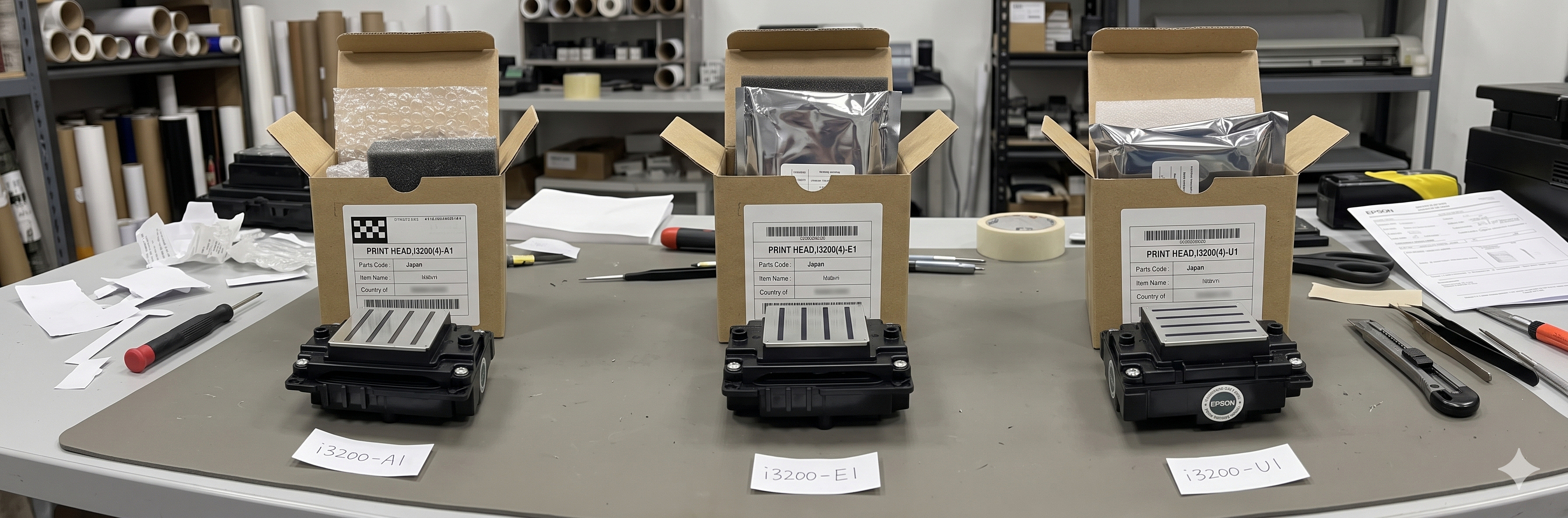
Epson i3200 A1 vs E1 vs U1: The 30-Second Answer
The Epson i3200 is one machine platform with three ink personalities, and the letter at the end of the code tells you everything: A1 runs water-based inks (sublimation and DTF textile pigment), E1 runs eco solvent ink, and U1 runs UV-curable ink. The hardware inside all three is identical — the difference is the ink-facing materials and the drive tuning. So the question is never "which head is best" but "which ink does your machine run". Match the head to the ink, and the head will last; mix them up, and a brand-new head can die within days.
| If your machine is a… | You need | Ink it runs |
|---|---|---|
| DTF printer for t-shirt transfers | i3200-A1 | Water-based textile pigment (DTF) ink |
| Sublimation textile printer | i3200-A1 | Sublimation dye ink |
| Eco solvent printer — vinyl, flex, stickers | i3200-E1 | Eco solvent ink |
| UV flatbed or UV roll-to-roll printer | i3200-U1 | UV-curable ink |
| UV DTF crystal label machine | i3200-U1 | UV ink printed on A/B film |
Every row above has one thing in common: the ink family decides the head. Now let us look at what each version actually does in a working shop.
What Do A1, E1 and U1 Mean on an Epson i3200 Printhead?
All three versions share the same PrecisionCore thin-film piezo platform: 4,720 nozzles arranged in four rows of 1,180, a 1.3-inch print width, 600 dpi native resolution with variable-size droplets, and four data channels per head. Epson builds one physical head and then tunes each variant for a specific ink chemistry — the nozzle plate coating, the seal materials and the piezo waveforms are matched to the viscosity and surface tension of that ink family.
That is why the suffix is not a performance grade. An E1 is not a "better" or "newer" head than an A1 — it is a different tool for a different ink. Think of it like engine oil: the same engine, but you would never pour the wrong grade in and expect it to survive. The same logic makes the i3200 family simple to buy: identify your ink, buy that letter, install with matched consumables.
Epson i3200 A1: The Head for DTF and Sublimation Printing
The A1 is the water-based workhorse, and in India it dominates two businesses. The first is DTF printing: most multi-head DTF machines run two, three or four A1 heads, with dedicated channels assigned to white ink. The A1 handles DTF textile pigment ink cleanly, and the whole chain — DTF inks, DTF powder, film, oven and press — is built around it. The second is sublimation printing: sportswear, polyester merchandise and photo panels, where sublimation dye ink passes through the A1 at production speed.
Care points for the A1 are simple but non-negotiable. DTF white pigment settles fast, so the circulation and stirring system must run every day, and the machine should print something daily — even a small test swatch keeps nozzles healthy. If you are comparing head options for a t-shirt setup, this is your head: see the i3200-A1 product page for details.

Epson i3200 E1: The Head for Eco Solvent Printing
The E1 is the eco solvent variant, tuned for the mild, slow-evaporating solvent inks used across the sign industry. It is the head inside modern eco solvent printers doing vinyl sticker printing, flex banners, one-way vision, vehicle branding and label stock. For shops moving up from older DX5 or XP600 machines, the E1 brings the i3200 platform's wider nozzle row and faster production speeds to everyday eco solvent work.
One boundary matters here: eco solvent means mild solvent. Aggressive true-solvent inks belong to industrial heads like the Konica and Seiko families — pushing true solvent through an E1 corrodes the nozzle plate quickly. If your production mix includes heavy outdoor solvent jobs, browse the Konica and Seiko head ranges instead. For standard eco solvent vinyl and flex work, the E1 is exactly right — see the i3200-E1 product page.

Epson i3200 U1: The Head for UV and UV DTF Printing
The U1 is the UV-curable variant, built for inks that harden instantly under a UV LED lamp. It powers three growing businesses. First, UV printers — flatbeds printing directly on acrylic, glass, wood, tiles and boards, plus roll-to-roll machines on flexible media. Second, UV DTF crystal label machines like the UVDTF 310, where the U1 prints CMYK plus white onto A film for peel-and-stick labels on bottles, phone covers and gifts — browse the UV DTF printers range. Third, industrial decoration jobs where instant curing and surface hardness matter.
UV ink has one special quirk: it cures anywhere light and time allow, including inside the head. That is why U1 machines run white ink stirring and scheduled purge cycles — a U1 left idle over a long weekend can cure ink in the nozzles. Used daily with proper circulation, the U1 is the most profitable head in the decoration business — see the i3200-U1 product page.

Epson i3200 A1 vs E1 vs U1: Side-by-Side Comparison Table
The hardware rows are identical across all three versions — scan down the ink rows to see where they part ways.
| Feature | i3200-A1 | i3200-E1 | i3200-U1 |
|---|---|---|---|
| Ink family | Water-based (aqueous) | Eco solvent | UV-curable |
| Typical machines | DTF, sublimation | Eco solvent printers | UV flatbed, roll-to-roll, UV DTF |
| Main applications | T-shirts, sportswear, polyester prints | Vinyl, flex, stickers, vehicle graphics | Boards, glass, acrylic, bottles, covers |
| White ink usage | Heavy — DTF white needs daily circulation | Rare — mostly CMYK | Heavy — white UV needs stirring and purges |
| How ink sets | Absorbs or cures with powder oven | Evaporates | UV LED lamp — instant |
| Nozzles / width / dpi | 4,720 / 1.3 in / 600 dpi | 4,720 / 1.3 in / 600 dpi | 4,720 / 1.3 in / 600 dpi |
| Wrong-ink risk | Eco or UV ink kills the head | Water or UV ink kills the head | Solvent or water ink kills the head |
One sentence to remember: A1 prints fabric, E1 prints vinyl, U1 prints everything rigid — and each refuses the other two jobs.
What Every i3200 Version Has in Common
Because the variants look identical online, buyers often ask what actually differs. The honest answer: on the spec sheet, almost nothing — and that is by design. All three share:
- PrecisionCore thin-film piezo architecture — Epson's industrial-grade firing system for production duty cycles.
- 4,720 nozzles in four rows — more nozzles per pass means fewer passes and faster output than older DX5-class heads.
- 1.3-inch print width and 600 dpi native resolution with variable-size droplets for smooth gradients and sharp text.
- Four data channels per head — how multi-head DTF and UV machines dedicate channels to white ink.
- Identical daily care routine — capping, wiper cleaning, stable power, dampers without air, and printing something every day.
- Similar physical footprint — the variants fit the same class of carriages and cradles, which is why machines are designed around the family.
The performance you get depends far more on the ink and maintenance than on the letter at the end of the code.
Can You Run Different Inks in an i3200 A1, E1 or U1?
No — and this is the single most expensive mistake buyers make with this family. Each variant's nozzle plate, seals and piezo waveforms are engineered for one ink chemistry. Run eco solvent ink in an A1 and the solvent attacks seals and plate coatings within days. Run water-based ink in a U1 and it never cures correctly inside the channel, causing crossover and corrosion. Run anything aggressive in any i3200 and the result is the same: permanent nozzle loss, and a warranty claim that will be refused, because the damage is unmistakable.
Which i3200 Head Should You Buy? Match It to Your Machine
The choice takes one minute once you know what your machine runs. Here is the practical split we see across Indian shops every week:
Buy the A1 if you run…
A DTF t-shirt setup, a sublimation production line, or any water-based textile pigment job.
Buy the E1 if you run…
An eco solvent printer doing vinyl stickers, flex, one-way vision or vehicle branding.
Buy the U1 if you run…
A UV flatbed or roll-to-roll printer, or a UV DTF crystal label machine for bottles and covers.
Still unsure? Read the label on the head currently fitted in your machine — the variant code is printed on it. If the label is gone, the machine manual or the ink you are using tells the same story: water-based means A1, mild solvent means E1, UV means U1.
Buying an Epson i3200 Printhead in India: 5 Checks Before You Pay
The i3200 is a high-value part, and the market has its share of old stock, refills and mislabelled variants. Five checks protect your money:
- Match the exact code. A1, E1 and U1 are not interchangeable — confirm the variant from your old head's label or the machine manual before ordering.
- Confirm it is original. Sealed packaging, intact Epson labelling and serial, and no signs of resealing. If the price looks too good, it usually is.
- Replace the consumables with it. Fit fresh dampers with the new head, and make sure your ink is matched to the variant — old dampers seed air and debris into a new head.
- Demand a nozzle test. Ask for an unboxing video or an on-arrival test print showing a clean nozzle pattern before you sign off.
- Buy from a supplier who stocks all three. A specialist confirms the variant for your machine, tests the head and supports you after installation. Contact KingJet with your machine model and we will confirm the right i3200 for it.