
Is a roll to roll label cutting plotter right for you?
A roll to roll label cutting plotter feeds label stock continuously from an unwind roll, cuts labels dielessly — kiss-cut or through the liner — and winds the finished roll on a take-up. No rotary dies, no per-design tooling cost, and camera registration for printed label rolls. It is the standard entry into custom label production. If your runs are one design in the millions, a rotary die press still wins; for everything short to medium, the plotter is faster to start and cheaper per design.
| Your label work | Right machine |
|---|---|
| Printed label rolls, contour-cut designs | Roll to roll plotter with camera registration |
| Blank label stock, barcode and shipping labels | Roll to roll plotter |
| Kiss-cut sticker rolls, labels that peel off | Roll to roll plotter with kiss-cut setup |
| One design in millions, long food or pharma runs | Rotary die press |
Kiss-cut labels
Cut the face, keep the liner intact.
Printed roll contour
Camera reads marks, cuts the print.
Die-less cutting
New shapes from files — no die cost.
What Is a Roll to Roll Label Cutting Plotter?
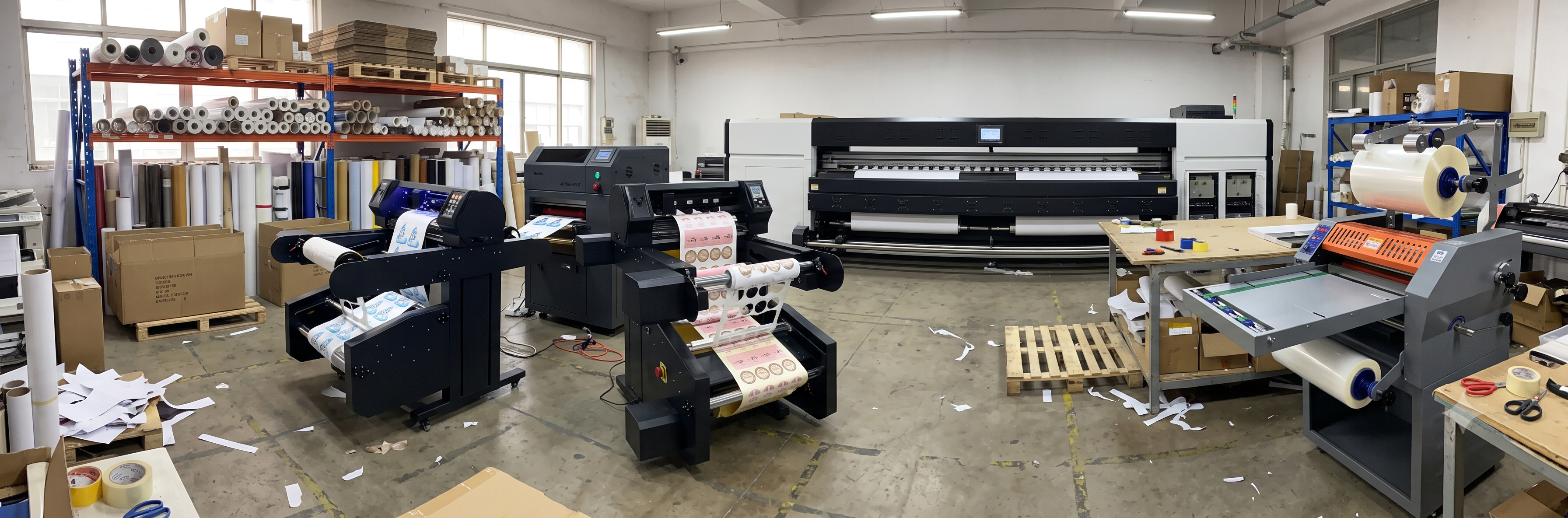
Roll in, labels out, continuously
A roll to roll label cutting plotter is a cutting plotter built around continuous label production. Label stock — paper, PP, PET, or BOPP labels on a liner — feeds from an unwind roll, passes under the cutting head in one continuous run, and the finished roll winds onto a take-up. There is no die to order: every label shape comes straight from a file.
- Continuous feed — metres of labels cut in one pass, not sheet by sheet
- Die-less cutting — new label designs cost nothing but a file
- Kiss-cut or die-cut in the same machine, depth set per material
- Camera registration for printed label rolls — contour follows the print
- Finished work rewinds as a roll, ready for dispensers and applicators
The cutting platform is familiar — blades, cutting strips, pinch rollers, and an optical eye like any plotter — but the unwind, tension control, and take-up are tuned for thin label stock with liners, where a torn liner or shifted roll ruins metres of material.
Best for: label producers, print shops adding labels, e-commerce sellers, and brands doing their own product labels.
How It Works: Kiss-Cut, Die-Cut and the Continuous Cycle
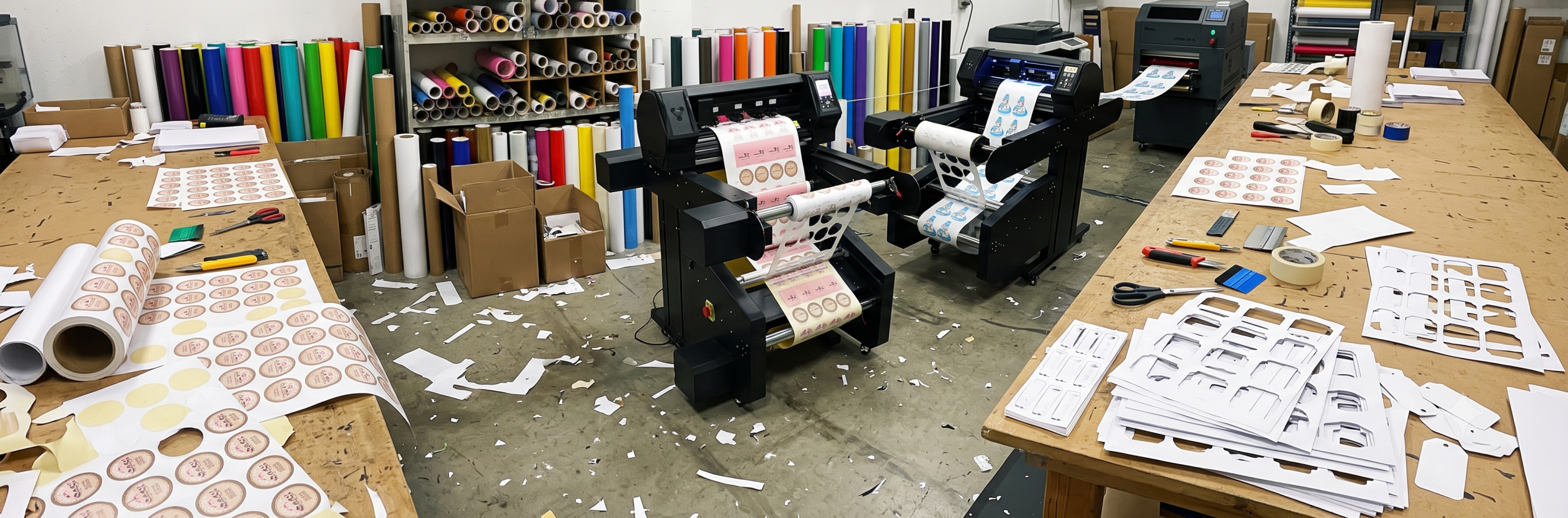
The two cuts, one depth setting apart
Label work lives on one precision setting: how deep the blade goes.
- Kiss-cut: the blade cuts through the label face material and stops on the liner. Labels peel off cleanly while the liner stays whole — the standard for sticker rolls and dispenser labels.
- Die-cut / through-cut: the blade cuts through label and liner together, separating labels fully — used for cut pieces and hand-applied labels.
- Depth setting: set blade depth on your actual stock — test-cut, peel a label, and check the liner for cuts. Too shallow tears labels; too deep scores the liner and breaks it on the roll.
The continuous cycle
- Load: mount the label roll on the unwind and thread through to the pinch rollers
- Register: on printed rolls, the camera reads registration marks and maps the cut to the print; on blank stock, the file cuts straight from the template
- Cut: the plotter runs the job continuously — hundreds of labels per pass at production speed
- Take up: the finished roll or matrix winds onto the take-up, ready for the next process
Tension matters as much as depth: steady unwind tension keeps registration marks aligned over long runs. Machines with proper tension control hold contour accuracy from the first label to the last.
Best for: consistent label output where liner integrity and contour accuracy decide the customer's experience.
Label Jobs a Roll to Roll Plotter Earns On
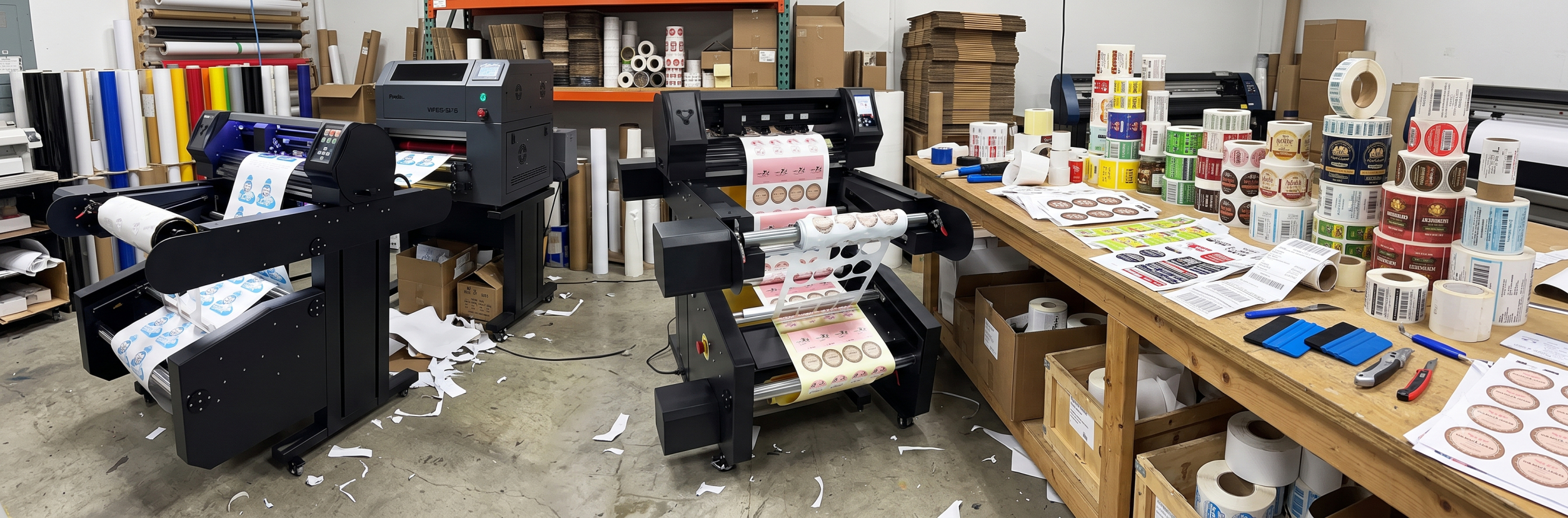
The daily label workload
Roll to roll plotters cover the label work most Indian shops actually get: short runs, changing designs, and urgent orders.
- Product labels: food, beverage, cosmetics, and jar labels — new designs per batch without new dies
- Barcode and shipping labels: blank stock cut to shape for logistics and retail
- Printed sticker rolls: printed rolls contour-cut on camera — kiss-cut stickers that peel from the roll
- Pharma and chemical labels: small-batch compliant labels with variable designs
- Wine and craft labels: decorative shapes and premium contours on specialty stock
- Warranty and serial labels: numbered and coded labels on PP and PET
Material range: paper labels, PP, PET, BOPP, vinyl label stock, and specialty films — all with liners. Metallic and textured stocks cut too, though abrasive or very thick faces consume blades faster.
Best for: print shops finishing label rolls in-house, and label startups serving local brands and e-commerce sellers.
Specs that matter on a roll to roll label plotter
Label stock is thinner and less forgiving than vinyl. These six specs decide whether a machine runs your rolls cleanly.
| Spec | Why it matters | What to check |
|---|---|---|
| Roll width | The widest label stock you can run | Common: 24 in, 34 in classes — match your roll stock |
| Roll weight & diameter | Heavy label rolls stress the unwind | Match capacity to the full rolls you buy |
| Kiss-cut depth control | Liner integrity is the quality test | Fine depth adjustment with repeatable settings |
| Camera registration | Contour cutting of printed rolls | Essential for printed labels — test on a skewed print |
| Speed | Continuous metres per hour | Higher speed pays on repeated label production |
| Take-up & tension | Clean rewind, aligned marks over runs | Steady tension control and a reliable take-up reel |
Quick rules
- Liner integrity sells labels — a scored liner tears on the applicator and costs the customer.
- Test the camera on your own printed roll with deliberate skew, not a showroom demo.
- Label blades dull faster on abrasive and metallic faces — price spares with the machine.
- Check that cutting strips and pinch rollers for label widths are stocked locally.
Roll to roll plotter vs rotary die press vs sheet cutting
| Feature | Roll to roll plotter | Rotary die press | Sheet-fed cutting |
|---|---|---|---|
| Die cost per design | None — file-based | Die per design | None, but sheet handling |
| Setup time | Minutes | Hours plus die making | Minutes |
| Best run length | Short to medium | Very long runs | Short runs |
| Design changes | Instant, new file | New die needed | Instant |
| Continuous roll output | Yes, rewind ready | Yes | No |
| Machine cost | Low | High | Low |
| Best for | Custom labels, changing designs | One design in millions | Sheet-based sticker work |
The practical picture: rotary die presses win only at very high volumes of one unchanged design. Everything else — new brands, seasonal designs, small-batch orders, urgent jobs — runs better on a roll to roll plotter, where a new shape costs a file instead of a die.
Roll to roll label cutting plotters available in India
Match the roll width to your label stock and printer output. Most label startups need less width than they think.
| Class | Roll width | Typical label work |
|---|---|---|
| Compact roll to roll | ~24 in | Product labels, barcode rolls, printed sticker rolls |
| Mid roll to roll | ~28–34 in | Wider label stock, multi-up layouts, larger rolls |
| Wide roll to roll | ~44 in and up | Full-width label webs and high-volume production |
What to check before you buy
- Roll width and weight capacity matched to the rolls you actually buy
- Kiss-cut depth precision tested on your own label stock and liner
- Camera registration demonstrated on your own printed roll, skewed on purpose
- Tension control steady across a full roll, first label to last
- Take-up reel included, with clean rewind of cut rolls
- Blades, strips, and rollers stocked locally — label runs consume blades
- Software that nests label layouts and reads registration marks reliably
A simple start: a 24 in roll to roll plotter with camera registration, a spare blade set, and your most common label stock covers most product and sticker label work. Add width when multi-up production becomes regular.
How to choose and set up a roll to roll label plotter
- Confirm the work. Printed and blank label rolls in changing designs point to a roll to roll plotter. One design in the millions points to a die press.
- Match the roll width. The machine must take the full width of the label stock you buy, with margin.
- Test the kiss-cut. Run your own label stock, peel a label, and inspect the liner under light — it must be intact.
- Test the camera. Print your own roll with marks, load it slightly skewed, and confirm the contour follows the print, not the sheet edge.
- Check the tension. Watch a long run — registration should hold from the first label to the last, with no drift.
- Build the workflow. Save depth, force, and speed presets per label material, and template your top label shapes.
- Stock the wear parts. Blades, cutting strips, and pinch rollers should be on your shelf, not on order — label production punishes downtime.