Konica 14pl or 42pl — which printhead should you buy?
14pl and 42pl are the two main types of the same Konica Minolta KM512 printhead platform — 512 nozzles on two staggered rows, 360 dpi nozzle pitch, and a 36.1 mm print width shared by both. The difference is the drop: the 14pl (Type M) fires a fine drop at up to 12.8 kHz with 4-level grey scale, while the 42pl (Type L) fires roughly three times the ink volume for dense solvent laydown. Neither is better in absolute terms — one buys you detail, the other buys you density. The right choice has two steps: match the type your machine was built for, then match it to the work you sell.
| Your work | Right choice |
|---|---|
| Flex banner and backlit solvent work with heavy coverage | 42pl |
| Detailed eco-solvent vinyl, small text, and photo panels | 14pl |
| Maximum ink density in the fewest passes | 42pl |
| Smooth gradients and fine text on solvent media | 14pl |
| Like-for-like replacement on an existing KM512 machine | Match the fitted type — M or L |
| A brand-new machine purchase today | Weigh the 1024i platform — see FAQs |
Konica 14pl
Type M — fine detail, grey scale, faster firing.
Konica 42pl
Type L — triple ink volume, heavy coverage.
Konica 1024i
Double the nozzles — the wider step up.
Konica 14pl (Type M) — the fine-detail head
What the 14pl does best
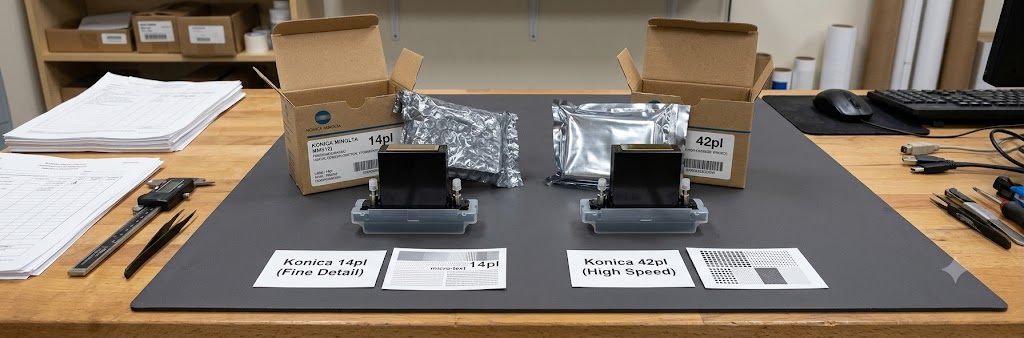
The 14pl is the Type M member of the KM512 family: 512 nozzles arranged on two staggered lines at a 360 dpi nozzle pitch, firing a fine drop at up to 12.8 kHz — nearly 70% faster than the 42pl type — with 4-level grey scale. That combination is why it renders small text, fine logos, and smooth gradients better than any bigger-drop rival on the same machine class. On eco-solvent vinyl and detailed signage work, the finer drop also means less bleed around sharp edges, which is exactly what customers notice on close-up viewing.
- 512 nozzles, 360 dpi nozzle pitch — the same platform as the 42pl
- Fires at up to 12.8 kHz — the fastest-firing KM512 type
- 4-level grey scale for smoother gradients and cleaner small text
- Fine drop keeps detailed artwork, small logos, and skin tones sharp
- Runs solvent ink on the standard MNX type; the MHX variant adds a heater and UV compatibility
Where it stops: density. On heavy-coverage flex banner jobs, the 14pl needs more passes or a slower machine speed to match the ink laydown a 42pl delivers in fewer passes — coverage speed is bought with drop volume, not firing rate.
Best for: eco-solvent vinyl, detailed signage, photo panels, and shops whose customers judge the print up close.
Konica 42pl (Type L) — the heavy-coverage head
What the 42pl does best
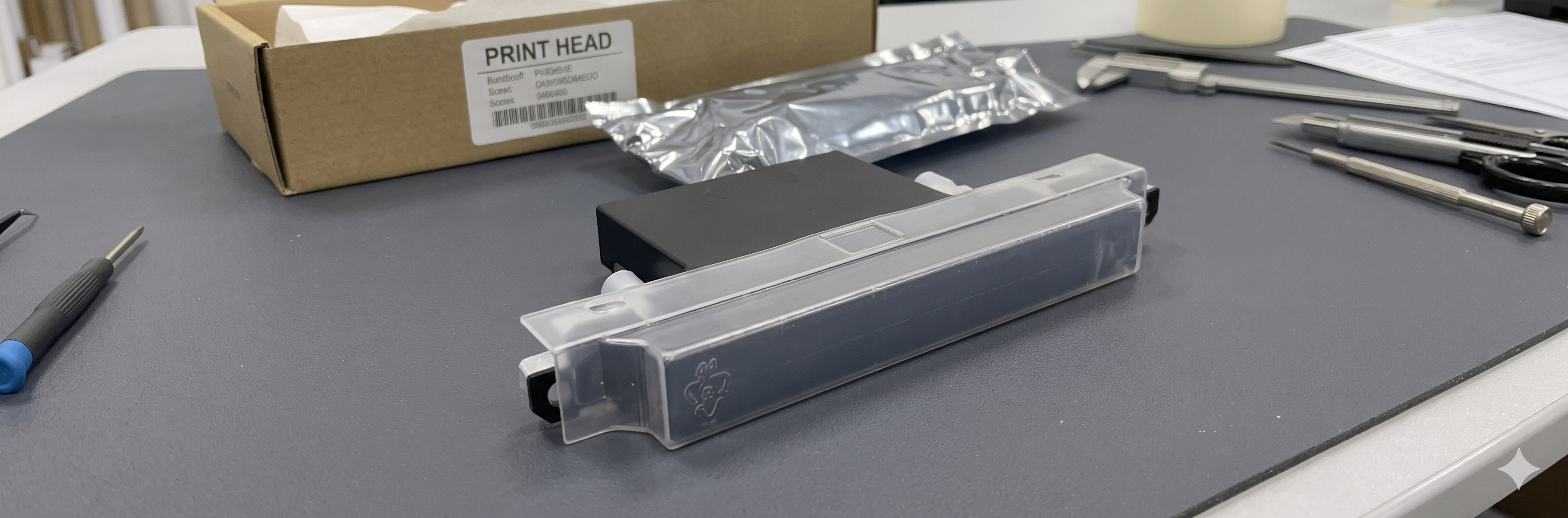
The 42pl is the Type L member of the KM512 family — the same 512-nozzle body, 360 dpi pitch, and 36.1 mm width, but each drop carries roughly three times the ink of the 14pl. On flex banner and PVC vinyl work, that volume turns directly into productivity: solid colour in fewer passes, deeper blacks on backlit material, and forgiving behaviour on coarse media in dusty shop air. It is the classic head of the Chinese flex and banner solvent fleet, and thousands of those machines across India still run on it.
- Roughly 3× the ink volume per drop — heavy coverage in fewer passes
- Built around solvent ink — the classic flex and banner head
- Same 512-nozzle, 360 dpi platform as the 14pl
- More forgiving of coarse PVC banner and hard-working shop floors
- The most common type in older solvent machine fleets across India
Where it stops: detail and supply. The bigger drop resolves less fine detail than the 14pl, fires slower at up to 7.6 kHz, and — like every KM512 type — is officially discontinued by Konica Minolta, so genuine stock tightens by the month.
Best for: flex banner and backlit solvent production where density and pass count matter more than micro-detail.
Konica 14pl vs 42pl — side by side
| Spec | Konica 14pl (Type M) | Konica 42pl (Type L) |
|---|---|---|
| Drop volume | 14pl fine drop | 42pl — ~3× the ink per drop |
| Nozzles / layout | 512 (256 × 2 staggered lines) | 512 (256 × 2 staggered lines) |
| Nozzle pitch | 360 dpi (70.5 µm effective) | 360 dpi (70.5 µm effective) |
| Print width | 36.1 mm | 36.1 mm |
| Max firing frequency | 12.8 kHz | 7.6 kHz |
| Grey scale | 4 levels | Not featured |
| Ink density per pass | Moderate | Highest — dense laydown in fewer passes |
| Image detail | Finer — text, logos, gradients | Solid colour, less micro-detail |
| Standard ink family | Solvent (MNX); MHX adds UV + heater | Solvent (LNX); LHX adds UV + heater |
| Production status | Discontinued — genuine stock tightening | Discontinued — genuine stock tightening |
| Price position | Both set by scarce genuine stock — compare live quotes with a nozzle test | |
| Best for | Detail and image quality | Density and pass speed |
Specifications from Konica Minolta's official KM512 series documentation (LNX/MNX types) and industry references; a rare 4pl Type S exists for coding and marking niches. Confirm the exact variant fitted in your machine against its datasheet before ordering.
Konica printhead price in India — what you actually pay
Konica printhead prices in India are now driven by supply more than by specification. Konica Minolta discontinued the standard KM512LNX and KM512MNX types as of August 2026, which means genuine stock only shrinks while the huge installed flex and banner fleet keeps needing like-for-like replacements. Expect tested genuine units to carry a rising premium, and expect the market to be flooded with used, refurbished, and disassembled heads priced to look like bargains.
| Head | Price position | Why |
|---|---|---|
| Konica 14pl (Type M) | Premium on genuine stock | Discontinued — detail-critical solvent fleets still demand like-for-like replacements |
| Konica 42pl (Type L) | Premium — varies with stock cycles | Discontinued; the classic banner fleet keeps replacing the same type |
| Konica 1024i class | Higher than KM512 | The newer, wider Konica platform — check current production status before buying new |
Compare the full kit, not just the head: a nozzle test before dispatch, the dampers and cables your machine needs, a GST invoice, and a dead-on-arrival replacement policy all belong in the same calculation. Treat a quote far below market as a warning, not a bargain — used and disassembled heads are the single biggest risk in this market. Browse KingJet's genuine printhead range with nozzle-tested stock and pan-India delivery.
Which ink and printer type fits each Konica head
Head, ink, and machine are tuned together. Both 14pl and 42pl are shared-wall piezo heads built around solvent ink, but each earns its place in a different kind of work. Decide what you print first — the head choice follows from it, not the other way round.
| Your printing | Best fit | Why |
|---|---|---|
| Solvent flex banner, backlit, coarse PVC | 42pl | Triple drop volume gives density in fewer passes on demanding media |
| Eco-solvent vinyl and detailed signage | 14pl | Fine drop and grey scale keep small text and gradients clean |
| UV flatbed or roll-to-roll UV | Match the HX variant fitted | MHX/LHX types add an internal heater and UV ink compatibility |
| Like-for-like replacement | Same type as fitted | Waveforms, voltages, and ICC profiles are tuned per type |
Quick rules
- Banner shop printing heavy solvent daily? The 42pl buys you density in fewer passes — that is metres per shift.
- Selling fine detail — photo panels, small text, gradients? The 14pl is the type customers notice up close.
- Replacing a dead head? Match the fitted type exactly — Type M or Type L; profiles and drive settings are type-specific.
- Buying a new machine today? Shortlist 1024i-class platforms before investing deeper into a discontinued-head fleet.
- Weighing an Epson-head machine instead? Browse KingJet's eco-solvent printers for XP600-class alternatives.
Who should choose which head
| Buy the 14pl if... | Buy the 42pl if... |
|---|---|
| Your work is detail-critical — small text, photos, gradients | Your work is flex banner and backlit solvent volume |
| You want the finest output the KM512 platform can give | You want maximum ink density in the fewest passes |
| Your machine is a Type M (MNX/MHX) build | Your machine is a Type L (LNX/LHX) build |
| You can source tested genuine Type M stock at a fair price | You can source tested genuine Type L stock at a fair price |
The single deciding exercise: write down your last twenty print jobs and mark which ones were judged up close — photo panels, small text, fine logos — and which were viewed at banner distance. If detail jobs dominate, the 14pl protects your quality reputation. If banner and backlit volume dominates, the 42pl protects your throughput. And if your machine is already fitted with one type, replace like-for-like and spend the difference on genuine stock you can verify.
What to check before you buy any Konica printhead
- Type match first — order the exact fitted type (14pl Type M or 42pl Type L); waveforms, voltages, and dampers are tuned per type
- Genuine vs disassembled — the biggest risk in the Indian market; insist on a nozzle test video or a live test print before payment
- Ink family match — confirm the variant is tuned for your ink (solvent, eco-solvent, or UV on heater variants) and that ICC profiles exist
- Complete kit — dampers, cables, capping station compatibility, and cleaning solution in the same purchase
- Dead-on-arrival policy in writing — heads are wear items, and the DOA window is your only protection
- Support after the sale — a technician who can guide a head swap and first-time ink charging decides your downtime more than any spec sheet
A simple start: the right type for your machine, two spare dampers, one litre of cleaning solution, and your regular ink stock covers the first month of real work without a single waiting day.
How to decide between the 14pl and 42pl
- Confirm the type your machine is built for. This decides everything for a replacement — Type M or Type L, no mixing.
- List what you print. Flex banner, eco-solvent vinyl, or UV products — the ink family and media point to the work the head must do.
- Judge your customers' viewing distance. Up-close detail work favours the 14pl; banner-distance density favours the 42pl.
- Count your real output. Square metres per day tells you whether pass-count savings from the 42pl matter to your shifts.
- Demo on your own designs. Ask for a nozzle test plus your best-selling artwork, and compare the clock, not just the demo file.
- Count the kit. Dampers, cables, cleaning solution, and a planned spare head matter as much as the head price.
- Buy from support. Nozzle test before dispatch, GST invoice, DOA policy, and a reachable technician decide your daily uptime more than any brochure.