
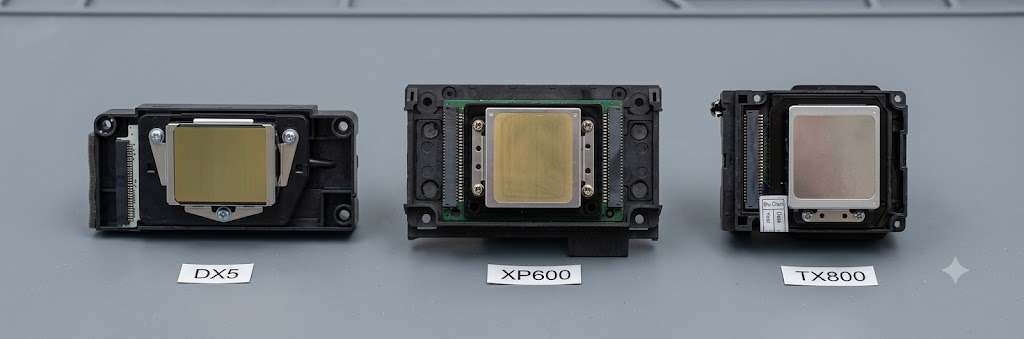
DX5, XP600 or TX800 — which printhead should you buy?
DX5, XP600, and TX800 are the three Epson printheads you will meet in almost every DTF printer, eco-solvent printer, and sublimation machine sold in India. All three are Micro Piezo heads, but they are not the same head at different prices — the DX5 leads on speed and colour, the XP600 leads on price and availability, and the TX800 is the DTF-and-sublimation specialist whose genuine stock is now tightening. The right choice has two steps: match the head to your machine's platform and ink, then match it to your daily volume and budget.
| Your work | Right choice |
|---|---|
| Fastest output with the richest colour — eco-solvent signage | DX5 |
| Lowest investment and the easiest genuine spares | XP600 |
| Like-for-like on DTF and sublimation machines fitted with it | TX800 |
| UV flatbed (6040/9060) and roll-to-roll UV printing | XP600 |
| Scaling DTF production to industrial volume | i3200 — see FAQs |
| A genuine replacement you can verify before paying | Match your machine's platform |
Epson DX5
The proven veteran — speed and colour.
Epson XP600
The value all-rounder — lowest cost.
Epson TX800
The DTF specialist — buy genuine.
Epson DX5 — the proven veteran
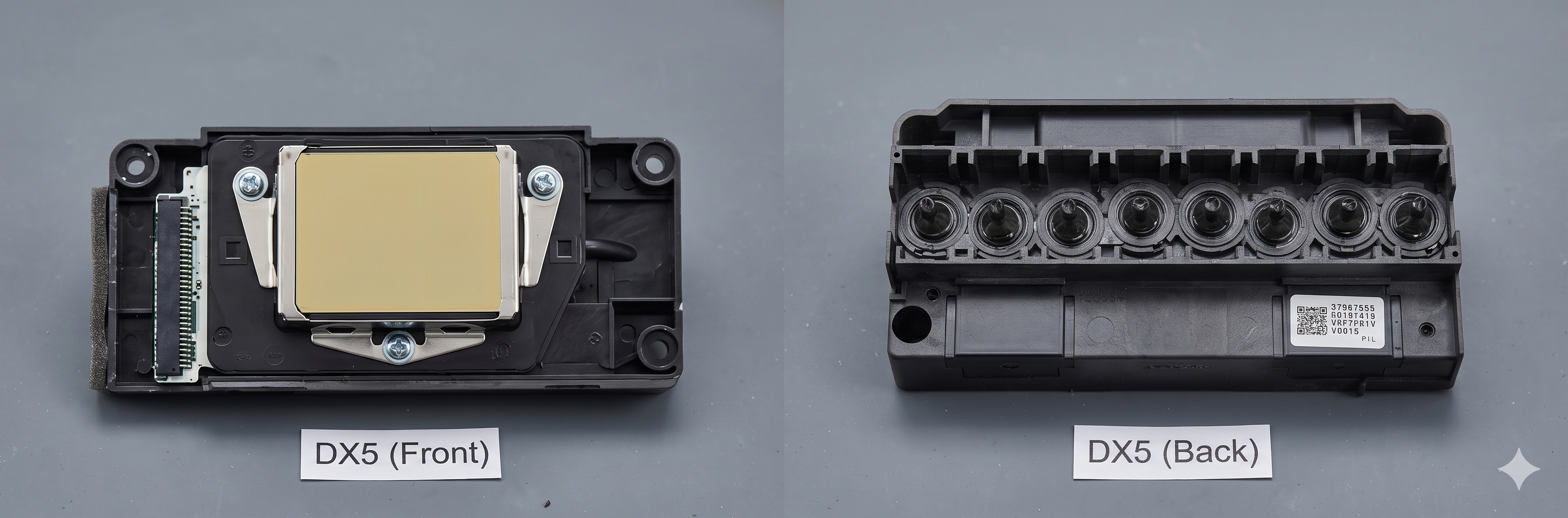
What the DX5 does best
The DX5 is the most recognised Epson printhead in wide-format printing, with a service history that runs through generations of eco-solvent machines. It carries 1440 nozzles across 8 rows and fires variable droplets from 3.8 to 22 pl, which is why its colour saturation is still the benchmark the newer heads are judged against. At 4-pass it prints roughly 12 to 15 square metres per hour — 10 to 20% faster than the XP600 — and with daily care it remains the longest-lived head of the three.
- Fastest of the three at 4-pass — 12–15 sqm/hour
- Richest colour saturation of the three — the benchmark for signage work
- 1440 nozzles on 8 rows with variable droplets of 3.8–22 pl
- Longest service life with daily cleaning and proper capping
- Every technician in the market knows how to service and revive it
Where it stops: price. Original DX5 supply has thinned while the installed fleet still demands it, so a genuine unit now costs the most of the three — the exact reason economical printer brands moved new machines to the XP600. If a DX5 is quoted far below market, assume it is used or disassembled.
Best for: eco-solvent signage and vehicle graphics, where speed and colour density win the job and the genuine premium is worth paying.
Epson XP600 — the value all-rounder
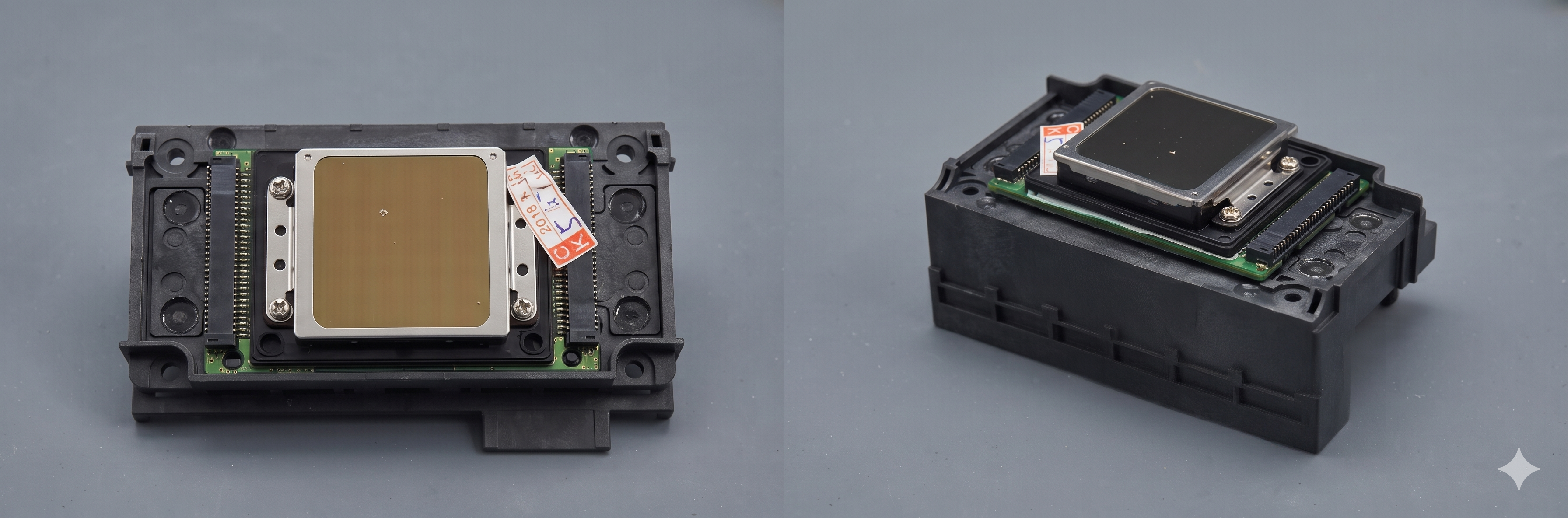
What the XP600 does best
Released around 2018 as the economical replacement for the DX5, the XP600 is a 6-channel head with 1080 nozzles on 6 rows. It prints 10 to 12 square metres per hour at 4-pass — 10 to 20% slower than the DX5 — but it costs roughly a quarter of the price, which is why it has become the default head in today's economical DTF, eco-solvent, and UV machines. You will find it fitted in everything from A3 DTF printers to 6040 and 9060 UV flatbeds, and in two-head eco-solvent builds like KingJet's KJ-3204S XP600 Series eco-solvent printers.
- Lowest price of the three — roughly a quarter of a genuine DX5
- Easiest genuine stock to find anywhere in India
- Runs DTF, eco-solvent, sublimation, and UV ink when tuned for each
- Standard fit on 6040/9060 UV flatbeds and 1.6–1.8 m roll UV printers
- Same workflow across brands — operators move between machines easily
The honest trade-offs: speed and life. The XP600 is 10–20% slower than the DX5, its colour saturation is slightly below the DX5 class, and a well-maintained unit reaches only 60–80% of a DX5's service life — under heavy daily duty, many owners count in months rather than years. Daily nozzle checks, proper capping, and clean ink decide the outcome far more than the badge.
Best for: DTF startups, UV printing, budget eco-solvent work, and any buyer who wants the cheapest genuine spare on the shelf.
Epson TX800 — the DTF and sublimation specialist
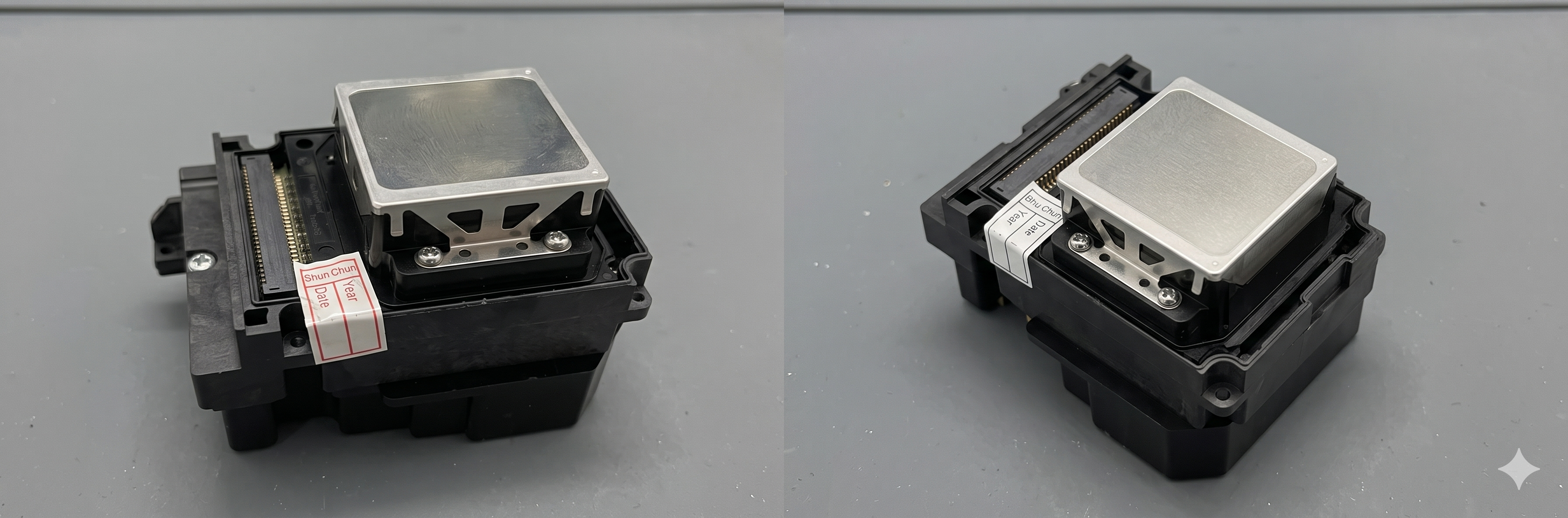
What the TX800 does best
The TX800 is an XP600-class head — 1080 nozzles on 6 rows at 1440 dpi with fine droplets from roughly 1.5 pl — that found its home in DTF and sublimation machines. It runs water-based, sublimation, eco-solvent, and UV ink, and it was positioned as a replacement step for the XP600 in DTF builds. If your A3 DTF printer or sublimation machine shipped with a TX800, staying on the same platform keeps your dampers, profiles, and technician's knowledge intact.
- Built around DTF and sublimation workflows
- 1080 nozzles, 1440 dpi, fine droplets from about 1.5 pl
- Common fitting in A3 DTF printers and sublimation machines
- Runs water-based, sublimation, eco-solvent, and UV ink
- Like-for-like replacement keeps your ICC profiles and spares valid
The honest trade-off: supply. Epson has discontinued the TX800, and industry sources report genuine stock is tightening with prices rising as a result. Buy only tested genuine units from a supplier who runs a nozzle test before dispatch — the second-hand and disassembled risk is highest exactly here.
Best for: owners of TX800-fitted DTF and sublimation machines who need a verified genuine like-for-like replacement.
DX5 vs XP600 vs TX800 — side by side
| Spec | Epson DX5 (F1440) | Epson XP600 (F1080) | Epson TX800 (F192040) |
|---|---|---|---|
| Nozzles / rows | 1440 / 8 rows | 1080 / 6 rows | 1080 / 6 rows |
| Variable droplet | 3.8–22 pl | 4.5–40 pl | ~1.5–21 pl |
| Speed at 4-pass | 12–15 sqm/hour | 10–12 sqm/hour | XP600-class DTF pace |
| Colour saturation | Highest of the three | Moderate | Moderate |
| Life with daily care | Longest — the benchmark | 60–80% of DX5 | XP600 class |
| Best-known inks | Eco-solvent, water-based, UV | DTF, eco-solvent, UV, sublimation | DTF, sublimation, eco-solvent, UV |
| Availability in India | Genuine stock thin | Widest and cheapest | Discontinued — tightening |
| Price position | Highest | Lowest — ~¼ of DX5 | Mid and rising |
| Best for | Signage speed and colour | Value — DTF, UV, starter builds | DTF / sublimation like-for-like |
Specifications compiled from industry references for the standard variants (DX5/F1440, XP600/F1080, TX800/F192040). Confirm against the official datasheet for your exact head revision before publishing or quoting.
Printhead price in India — what you actually pay
Printhead prices in India are driven by supply more than by specification. The XP600 is mass-produced and fits hundreds of machine models, so it is the cheapest genuine head to buy and the cheapest to keep as a spare. The DX5 sits at the top because original stock has thinned while the installed eco-solvent fleet keeps demanding it. The TX800, discontinued by Epson, is climbing as genuine units disappear.
| Head | Price position | Why |
|---|---|---|
| Epson DX5 | Highest of the three | Genuine supply has thinned; the installed eco-solvent fleet still demands it |
| Epson XP600 | Lowest — roughly a quarter of a DX5 | Mass production and wide machine compatibility keep it cheap and stocked |
| Epson TX800 | Mid and rising | Discontinued by Epson — genuine stock tightens by the month |
Compare the full kit, not just the head: a nozzle test before dispatch, the dampers and cables your machine needs, a GST invoice, and a dead-on-arrival replacement policy all belong in the same calculation. Treat a quote far below market as a warning, not a bargain — used and disassembled heads are the single biggest risk in this market. Browse KingJet's genuine Epson printhead range with nozzle-tested stock and pan-India delivery.
Which ink and printer type fits each head
Head and ink are tuned together. All three are Micro Piezo heads, but each is most at home in a particular machine class. Decide what you print first — the head choice follows from it, not the other way round.
| Your printing | Best fit | Why |
|---|---|---|
| Eco-solvent signage, vinyl, and flex | DX5 — XP600 on a budget | Both run eco-solvent; the DX5 leads on saturation and pace |
| DTF t-shirt film | XP600 or TX800 | Fine droplets lay white ink evenly — the two standard DTF fittings |
| Sublimation on polyester and blanks | TX800 or XP600 | The TX800 is tuned for sublimation workflows; XP600 for budget |
| UV flatbed and roll-to-roll UV | XP600 | The standard head on 6040/9060 flatbeds and 1.6–1.8 m roll UV |
Quick rules
- Signage shop printing daily? The DX5 pays you back in speed and saturation — if the genuine premium fits the budget.
- Starting a DTF t-shirt business? XP600 is the default for a reason — price, spares, and availability everywhere in India.
- Replacing a dead head? Match your machine's platform first — DX5 for a DX5 machine, TX800 for a TX800 machine.
- Scaling DTF to industrial volume? Shortlist i3200-fitted machines — see the FAQ below.
- UV custom products — phone cases, nameplates, gifts? The XP600 is the workhorse of the 6040/9060 flatbed class.
Who should choose which head
| Buy DX5 if... | Buy XP600 if... | Buy TX800 if... |
|---|---|---|
| You print eco-solvent daily and sell colour quality | Budget decides the purchase | Your DTF or sublimation machine is TX800-fitted |
| You want the fastest of the three | You want genuine spares anywhere in India | You can verify genuine, nozzle-tested stock |
| You maintain heads properly and want maximum life | You run DTF, UV, or starter eco-solvent work | You need like-for-like to keep spares and profiles valid |
| It is a like-for-like for an installed DX5 machine | It is your first machine | Your technician already knows the platform |
The single deciding exercise: write down your last twenty print jobs and total the square metres each kept the printer busy. If everything fits comfortably inside an XP600's pace and the colour holds up on your best-selling jobs, buy it with confidence. If colour density or metres per hour are costing you jobs, the DX5 premium pays for itself; if you are locked to a TX800 platform, secure verified genuine stock while it exists.
What to check before you buy any printhead
- Platform match first — the head must match your machine's mainboard, carriage, cable set, and dampers; it is not a universal part
- Genuine vs disassembled — the biggest risk in the Indian market; insist on a nozzle test video or a live test print before payment
- Ink family match — confirm the head variant is tuned for your ink (DTF, eco-solvent, sublimation, UV) and that ICC profiles exist
- Complete kit — dampers, cables, capping station compatibility, and cleaning solution in the same purchase
- Dead-on-arrival policy in writing — heads are wear items, and the DOA window is your only protection
- Support after the sale — a technician who can guide a head swap and first-time ink charging decides your downtime more than any spec sheet
A simple start: the right head for your machine, two spare dampers, one litre of cleaning solution, and your regular ink stock covers the first month of real work without a single waiting day.
How to decide between DX5, XP600 and TX800
- List what you print. DTF film, eco-solvent vinyl, sublimation blanks, or UV products — the ink family and machine class point to the head.
- Count your real output. How many square metres a day does the printer actually produce?
- Match the platform before the model. Your machine's mainboard and carriage decide which heads can be fitted at all.
- Match the head to the pace. XP600 for value, DX5 for speed and colour, TX800 for like-for-like DTF and sublimation, i3200 for production scale.
- Demo on your own designs. Ask for a nozzle test plus your best-selling artwork, and compare the clock, not just the demo file.
- Count the kit. Dampers, cables, cleaning solution, and a planned spare head matter as much as the head price.
- Buy from support. Nozzle test before dispatch, GST invoice, DOA policy, and a reachable technician decide your daily uptime more than any brochure.