Which DTF ink is right for your printing?
DTF ink is a water-based pigment ink that prints on PET film, takes hot-melt powder, and transfers to fabric with a heat press. It works on cotton, polyester, blends, leather, and every fabric colour including black. For t-shirt and apparel printing, a CMYK plus white DTF ink set is the standard choice.
| Your apparel work | Best ink |
|---|---|
| Cotton tees, hoodies, dark fabrics, all colours | DTF ink (CMYK + white) |
| Polyester sportswear, light-colour garments | Sublimation ink |
| Premium soft-hand tees, low daily volume | DTG ink |
DTF ink
Prints any fabric, any colour, through PET film.
Sublimation ink
Only for polyester and light garments.
DTG ink
Direct on cotton, soft feel, higher machine cost.
What Is DTF Ink and How Does It Work?
How the process works
DTF ink is a water-based pigment ink with special polymer binders. The printer prints the design in CMYK and then white on PET film. Hot-melt powder sticks to the wet ink, the film passes through a curing oven, and the print is ready. A heat press then transfers it to the fabric. The binder is the key — it is what lets the powder grip and survive washes.
- Works on cotton, polyester, blends, leather, and canvas
- White underbase means bright prints on black and dark fabrics
- No pre-treatment needed, unlike DTG printing
- One printed film can be stored and pressed later
The full chain matters: DTF ink, PET film, hot-melt powder, and curing must all match. Good ink with the wrong powder or wrong curing temperature will fail the wash test.
Best for: t-shirt businesses, custom apparel, caps, tote bags, and uniforms in any colour.
Types of DTF Ink: White and CMYK Pigment Ink
What comes in a DTF ink set
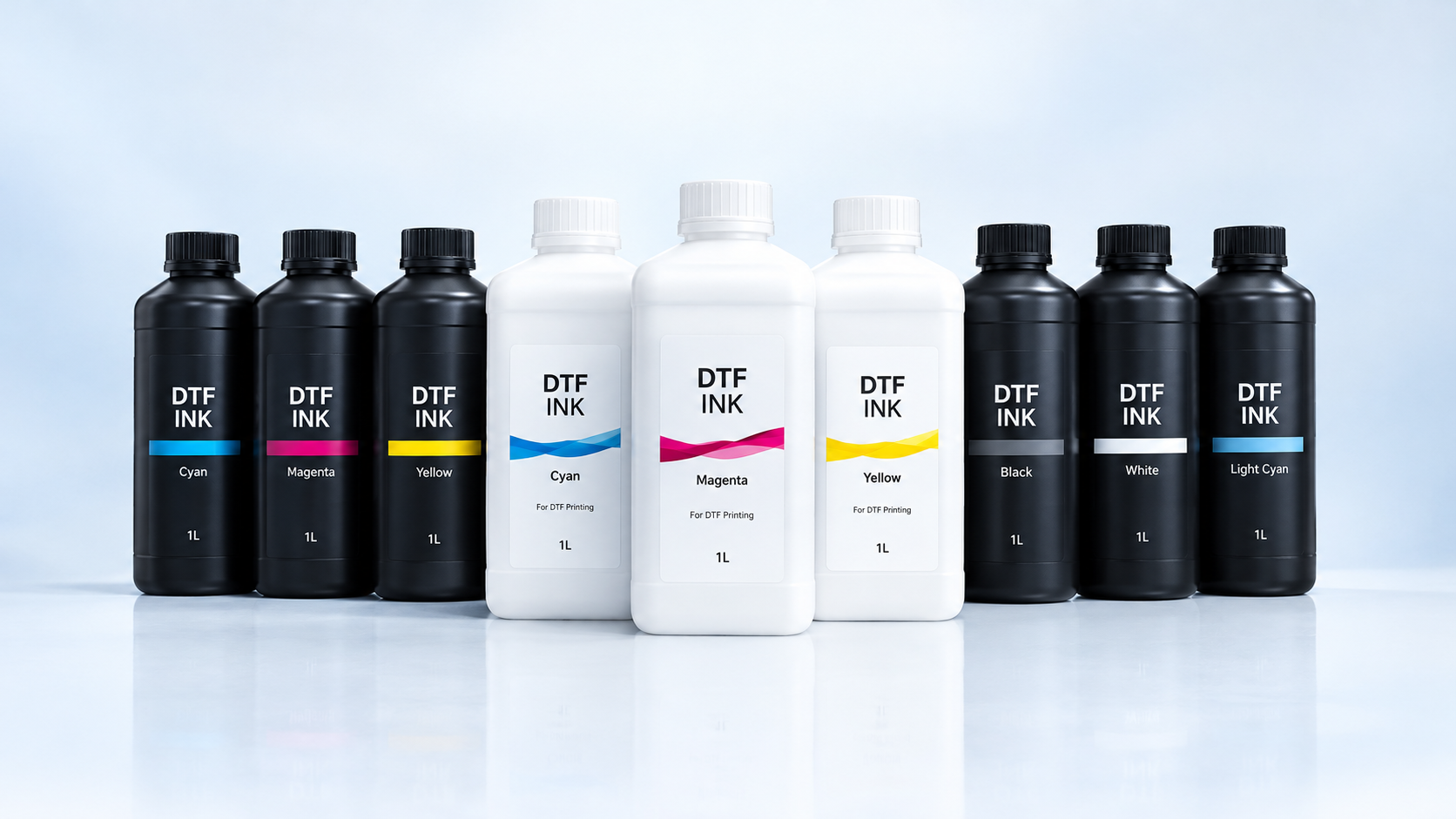
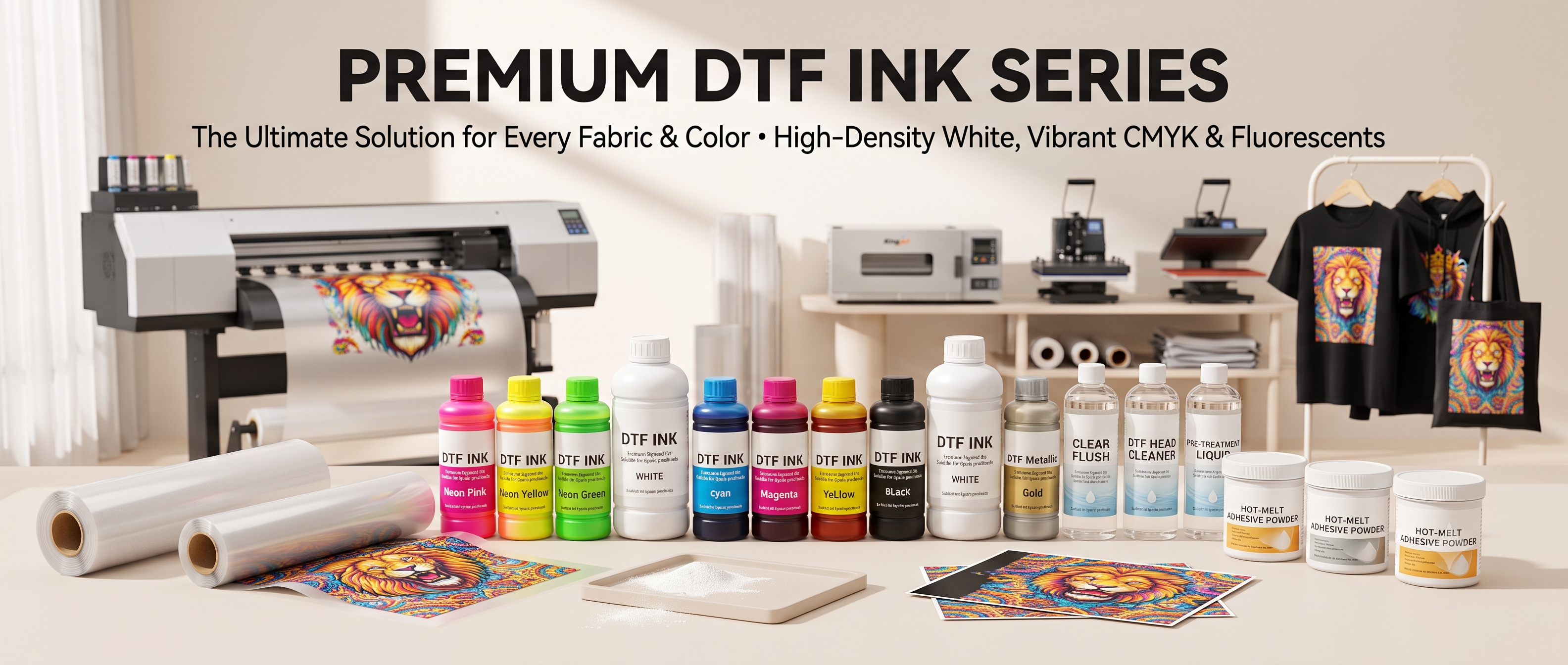
A standard DTF ink set has six channels: cyan, magenta, yellow, black, and two white, or CMYK plus one white with one flush channel. The colours are pigment inks with binder. The white is thicker, with heavy titanium dioxide pigment, and it prints first as the underbase that makes colours pop on dark fabric.
- CMYK DTF ink: the colour layer. Flows easily and behaves like a normal pigment ink.
- White DTF ink: the underbase. Thick, settles fast, and needs circulation or daily stirring. This is the channel that decides whether your DTF printer runs smoothly or clogs.
- Cleaning / flush solution: matched to the ink brand. Keep a dedicated bottle for the white channel.
Never mix DTF ink with sublimation or solvent ink in one machine. The chemistry is different, and mixing them kills the head and ruins the powder bond.
Best for: every DTF setup uses the same family — the difference between brands is whiteness, binder quality, and how well the white holds up in the lines.
DTF Ink for T-Shirt Printing and Apparel Business
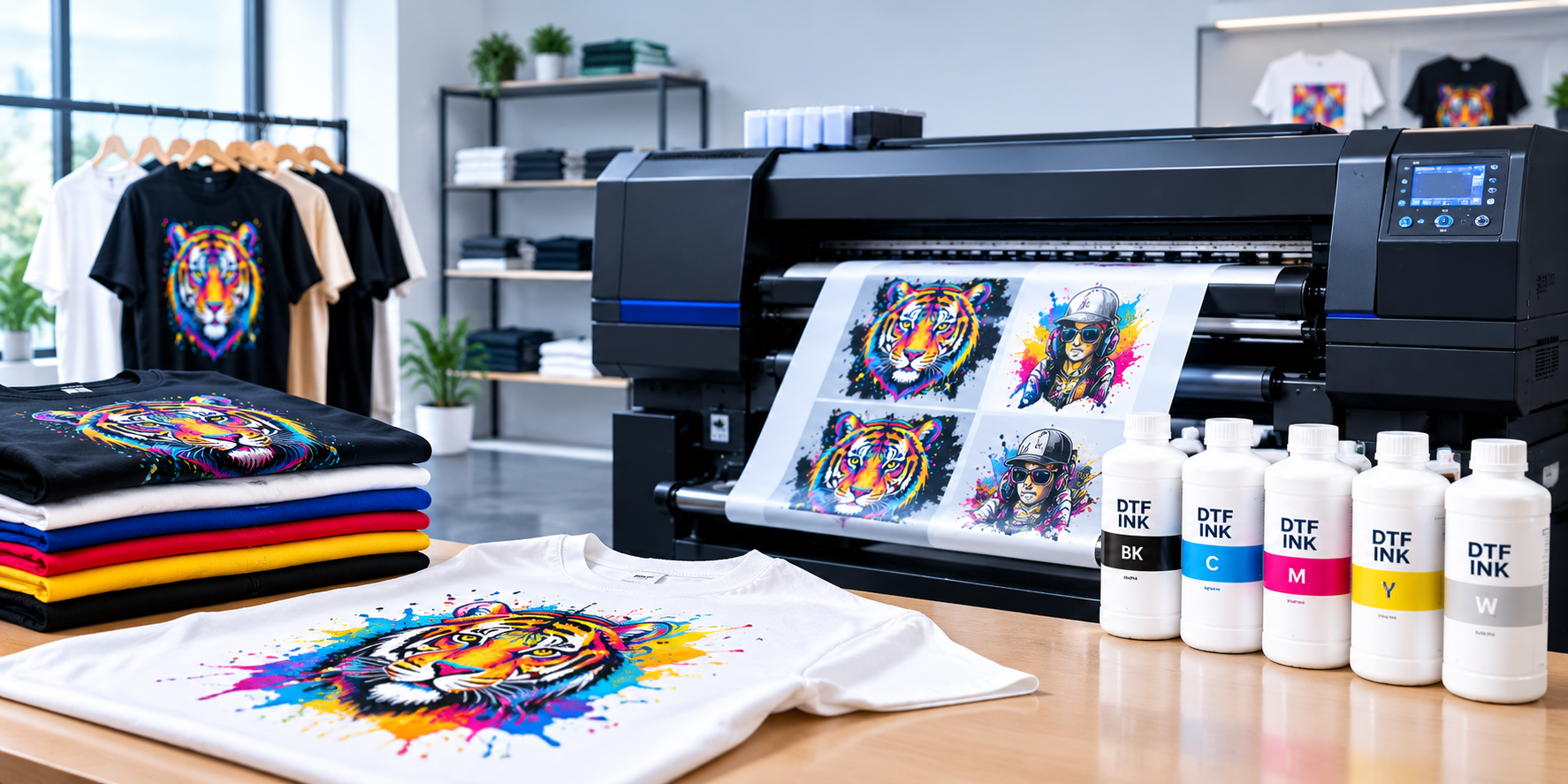
Why apparel shops pick DTF
DTF ink is the reason small shops can offer printed t-shirts without pre-treatment machines or polyester-only limits. Print a batch of transfers in the morning, cure them, and press on demand through the day. The entry cost is low because most setups start on an Epson-head printer.
- Good: prints on every fabric and every colour, including black
- Good: 30 to 60 washes with proper pressing and curing
- Good: transfers can be stored and pressed when orders come
- Limit: slight hand feel from the powder layer, softer after first wash
- Limit: white ink must run daily or the lines clog
Ink consumption: an A3 full-coverage transfer uses roughly 15 to 20 ml of DTF ink including white, and white is usually the biggest share. Plan the cost per print with ink, powder, and film together, not ink alone.
Best for: t-shirt shops, custom gifting, uniform suppliers, and print-on-demand starters.
DTF ink and printhead compatibility
DTF ink is made for Epson piezo heads. The head grade decides the ink grade — an ink made for a starter head can clog a production head, and a production-grade ink may not flow right in a starter machine. Match both.
| Printhead | Ink grade | Where you see it |
|---|---|---|
| Epson L1800 / L805 | Starter DTF ink, 6-channel for CMYK + white | Beginner DTF machines |
| Epson XP600 | Mid-production DTF ink | Small shop DTF printers |
| Epson i3200 | Production DTF ink, fast daily runs | Commercial DTF printers |
| Epson TX800 | Production DTF ink | High-volume DTF printers |
Quick rules
- DTF ink only runs on Epson piezo heads. It is not for solvent, UV, or sublimation machines.
- White ink needs a circulation or stirring system. A printer without one needs manual stirring every day.
- Use the cleaning fluid from the same ink brand family. Mixing fluids can gel the white.
- Changing DTF ink brands? Flush the full system first, including dampers and the white channel.
Best DTF ink brands available in India
You need one DTF ink brand that matches your head, one steady supplier, and powder and film that work with it. Indian shops usually pick from three groups.
| Ink group | Best when | What you get |
|---|---|---|
| Original machine-maker ink | You want zero risk on a new DTF printer | Matched profiles and warranty safety |
| Indian DTF ink brands | Daily apparel volume at low cost | Good whiteness, litre packs, easy local stock |
| Imported DTF ink grades | XP600 and i3200 production machines | Head-specific grades, strong white coverage |
What to check before you buy
- Head grade: is the ink made for L1800, XP600, or i3200 specifically?
- Whiteness: print on black cotton and check the white underbase before buying bulk
- Wash test: press a sample and wash it 10 times before you commit
- Batch dates: white ink is freshest within 6 months of manufacture; ask for the date
- Supply: powder and film from the same supplier avoids bond problems
A simple start: an Epson L1800-based DTF printer with a starter-grade CMYK + white DTF ink set, matched powder, and A3 PET film. Upgrade to XP600 or i3200 ink grades when daily volume grows.
DTF vs sublimation vs DTG ink
| Feature | DTF ink | Sublimation ink | DTG ink |
|---|---|---|---|
| Fabrics | Cotton, polyester, blends, leather | Polyester only (65%+) | Cotton best |
| Dark colours | Yes, white underbase | No, light garments only | Yes, with pre-treatment |
| Pre-treatment | None | None | Required |
| Hand feel | Slight, softer after first wash | Zero, dye-based | Softest |
| Wash life | 30–60 washes | Permanent on polyester | Very good on cotton |
| Entry cost | Low | Low | High |
| Ink cost per print | Medium | Low | High |
| Typical heads | Epson L1800, XP600, i3200 | Epson heads | Epson DX5, i3200 |
How to choose and use DTF ink
- Match the head grade. L1800 takes starter ink, XP600 and i3200 take production ink. Never guess on this step.
- Plan the white. Check that your printer has circulation or that you can stir daily. White ink is the whole game in DTF.
- Ask for a black-fabric test. Print, powder, cure, and press on black cotton. Check whiteness and wash it ten times.
- Count the real cost. Ink plus powder plus film per A3 transfer matters more than the price per litre of ink.
- Store the ink right. Keep bottles sealed, cool, and away from sun. Shake white gently every week.
- Print every day. A daily nozzle check and a small purge on the white channel prevents weekend clogs.
- Check the supplier. Batch dates, matched powder and film, and steady local stock matter more than the lowest price.